

Sub-goal 2: Economic equality
Men earn more money than women, and the gap between the sexes is widening in Sweden. In addition to pay, several factors contribute to women not having the same opportunities as men to achieve economic independence, including conditions in the labour market, tax and pension systems, rates of sickness absence, and unpaid domestic and care work.
The goal is to achieve economic equality. Women and men should have the same opportunities and conditions in terms of paid work that provides economic independence throughout their lives.
What does the sub-goal include and why is economic equality important?
The Government's interpretation of economic independence is that women and men have the same opportunities and conditions to support themselves and any children they may have. One starting point is that women and men are individually responsible for supporting themselves. Taxes, benefits and social insurance systems linked to each individual promote a more equal distribution of both paid and unpaid work.
The sub-goal includes ensuring that women and men have the same opportunities and conditions when it comes to access to employment. The Government has identified differences between women and men in terms of pay, income, part-time work, insecure employment, career opportunities and sickness absence as particular challenges in the area of economic equality.
Similarly, the aim is for women to have the same opportunities as men to start and run businesses that can grow and generate an income. The economic security and independence that gender equality policy seeks to achieve should also apply during retirement.
Income gap between women and men is widening
Women's average disposable income is significantly lower than men's, by just over 20 per cent. Disposable income is based on income from employment, benefits and capital, minus taxes. Over the course of an entire lifetime, the difference amounts to SEK 6.3 million.
The latest figures from Statistics Sweden (SCB) show that the gap in disposable income between women and men is increasing. In 2024, men aged 20–64 had an average annual disposable income that was SEK 86,500 higher than that of women of the same age, corresponding to a difference of 26 per cent.
The gap is even larger among women and men over the age of 65. One important explanation for this development is that income from capital has increased more in recent years. On average, men own more capital than women, which accounts for part of the economic inequality.
Women's lower incomes can also be explained by the fact that women are more likely to be outside the labour market, work part-time and work in low-paid occupations. Women also take more parental leave, spend longer in education and have higher rates of sickness absence than men. Other factors include tax cuts on earned income and the abolition of the state income tax surcharge (värnskatt), which benefited men more than women.
Pay is lower in female-dominated occupations
The Swedish labour market is clearly gender-segregated. Twenty per cent of all women and 17 per cent of all men work in occupations with an equal gender distribution. This means that the vast majority work in occupations dominated by their own sex. To eliminate occupational gender segregation, half of all workers would need to change occupations.
Gender segregation has decreased over time, mainly because women have moved into previously male-dominated occupations requiring higher levels of education. Men remain underrepresented in many female-dominated occupations.
Occupations dominated by women, such as those in health and social care, have lower average pay and poorer working conditions than male-dominated occupations. Women's average monthly salary is SEK 39,000, compared with SEK 43,800 for men. This means that the gender pay gap is 10 per cent and has remained unchanged since 2019.
New rules on pay transparency
Pay differences between women and men will become more visible when the EU Pay Transparency Directive becomes part of Swedish law.
Major differences in part-time work and unpaid work
More women than men work part-time, although the proportion of women working full-time is increasing. One in five women, but only one in ten men, works part-time. An important reason for both women and men is that they are not offered full-time work. Other reasons that are more common among women than men include caring for children, other family-related reasons, and the work being physically or mentally demanding.
The proportion of women who report childcare as a reason for working part-time has decreased in recent years, while the proportion of part-time working men who cite caring for children or a close relative has almost doubled.
Single parents with children are a vulnerable group
A particularly vulnerable group is single mothers with children. Three out of four single parents with children are women. The economic circumstances of single mothers and fathers differ significantly.
Considerably more single mothers have a low standard of living and depend on social insurance benefits such as child and housing allowances. However, benefits for families no longer cover household expenses to the same extent as previously due to rising prices.
Women have lower pensions than men
Unequal pay and working conditions are also reflected in lower pensions for women than for men. Despite measures to reduce the pension gap between women and men, such as housing supplements, the differences remain substantial. In 2024, men generally received just over SEK 78,000 more per year in pension than women, corresponding to a difference of 24 per cent.
Among newly retired people in manual occupations, men's pre-tax pensions are SEK 4,000 higher than those of female manual workers. Women who have worked in professional or white-collar occupations receive an average of SEK 10,000 less in pension than men in the same type of occupation. Forty-five per cent of female manual workers' income-based pensions do not reach the level of the guaranteed pension.
Tax reforms over the past 20 years have contributed to increased income inequality. When the state income tax surcharge was abolished in 2020, it resulted in a larger tax reduction for men than for women. Another example is the earned income tax credits, which have contributed to income differences between women and men.
It is harder for foreign-born women than men to find work
Age, education, occupation, country of birth and disability are some of the factors that, together with gender, affect people's opportunities to work. Foreign-born women take longer than foreign-born men to establish themselves in the Swedish labour market, regardless of their level of education.
In recent years, somewhat more foreign-born women have entered employment, but there are still major differences within the group. People with higher levels of education find it easier to obtain employment, while women with lower levels of education and limited work experience find it more difficult to enter the labour market.
Women with disabilities have poorer conditions in the labour market than men with disabilities, but also compared with women and men in the population as a whole. They are more likely to be long-term unemployed, work part-time involuntarily and experience negative attitudes in working life. Women with disabilities are overrepresented among people living below the relative poverty threshold.
More businesses are owned by men
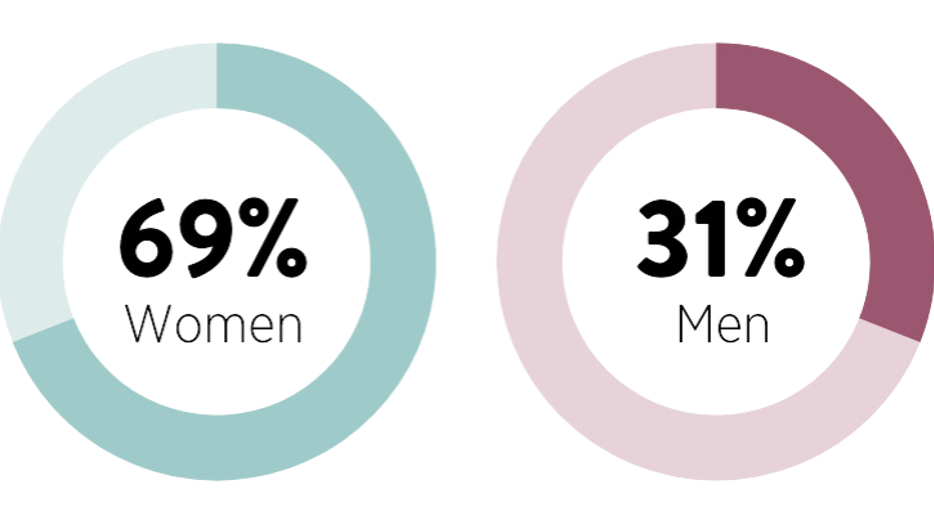
There are many gender inequalities when it comes to running businesses. Men run businesses to a greater extent than women. The proportion of self-employed people is twice as high among men as among women. In 2023, 30 per cent of people running businesses were women and 70 per cent were men. There are also major differences between women's and men's businesses in terms of ownership, capital and types of business.
Who owns a business is important, as ownership gives people the power to shape conditions for strategic decision-making and build financial capital, thereby creating personal wealth. There are currently no comprehensive statistics or definition of business ownership. Nineteen per cent of female board members also own shares in the company, compared with 28 per cent of male board members. Two out of three board members are men.
Women and men also start and run businesses in different sectors to a significant extent. More than nine out of ten businesses in the construction industry are started by men. Only one in four property companies is started by a woman, while in the health and social care and education sectors, women accounted for just over half of those starting businesses in 2023.
Men also own shares and property to a greater extent than women. This results in higher capital income for men, further increasing income inequality. Women have approximately half as much capital income as men.
What challenges are there to achieving an equal economy?
Women and men should have equal opportunities for economic independence. Women and men should be able to support themselves and any children they may have and be regarded as individually responsible for their own financial support.
The Swedish Gender Equality Agency highlights several important areas for achieving economic equality:
- Counteract gender segregation in the labour market.
- Raise the status and pay of female-dominated occupations.
- Improve working conditions and the work environment in female-dominated occupations.
- Take active measures to combat sexual harassment and discrimination in working life.
- Take the gender equality perspective into account when designing measures and reforms.
- Analyse reforms that appear to be gender-neutral but have a negative impact on gender equality, such as tax and pension systems.
- Promote women's entrepreneurship and ensure that a larger share of public support goes to women.
Publication date: 7 January 2022
Last updated: 15 August 2026